
Inlays, Onlays & Overlays in Pune
What Are Inlays, Onlays & Overlays?
Inlays, onlays, and overlays are custom-fabricated restorations used to repair teeth that have suffered moderate decay, fractures, or wear – damage that is too extensive for a direct filling to manage reliably, but does not require the full coverage of a crown. Each is made outside the mouth from durable, tooth-coloured material and bonded precisely into or over the tooth, restoring strength and function while preserving the maximum amount of healthy tooth structure.
The distinction between the three is defined by how much of the tooth they cover:
- Inlay: fits within the grooves of the tooth, replacing a damaged central area without extending over the cusps
- Onlay: extends over one or more of the tooth’s cusps, providing greater structural support where cusps are involved
- Overlay: provides more extensive coverage across multiple cusps, approaching that of a crown while still preserving healthy tissue that a crown would remove
All three are fabricated from the same high-quality ceramic materials used for crowns, and are designed using 3D digital scanning for a precise, seamless fit.
Who Should Consider an Inlay, Onlay or Overlay?
These restorations occupy the clinical space between a filling and a crown. You may be a candidate if:
- A cavity is too large for a composite filling to restore reliably, particularly in a back tooth under significant chewing load
- An existing large filling has cracked, failed, or is causing the tooth to flex under bite forces
- One or more cusps of a tooth are fractured or at risk of fracture
- A tooth has moderate wear or erosion that has compromised its biting surface
- You want the most conservative restoration that provides long-term durability, preserving more tooth than a crown requires
If you have been told you need a crown, it is worth asking whether an onlay or overlay is a clinically appropriate alternative. At Halo 32, we recommend the most conservative option that meets the clinical requirement, and will explain clearly why one restoration is more appropriate than another for your specific tooth.
Your Inlay, Onlay or Overlay at Halo 32
Assessment
Digital imaging and clinical examination determine the extent of damage, the condition of the remaining tooth structure, and which restoration, inlay, onlay, or overlay, is most appropriate. The choice is made conservatively: the restoration that preserves the most healthy tooth while adequately restoring strength and function.
Tooth Preparation
The damaged or decayed portion of the tooth is removed precisely under local anaesthesia. The preparation is shaped to receive the inlay, onlay, or overlay, removing only what is necessary and leaving as much healthy tooth structure as possible.
3D Digital Scan
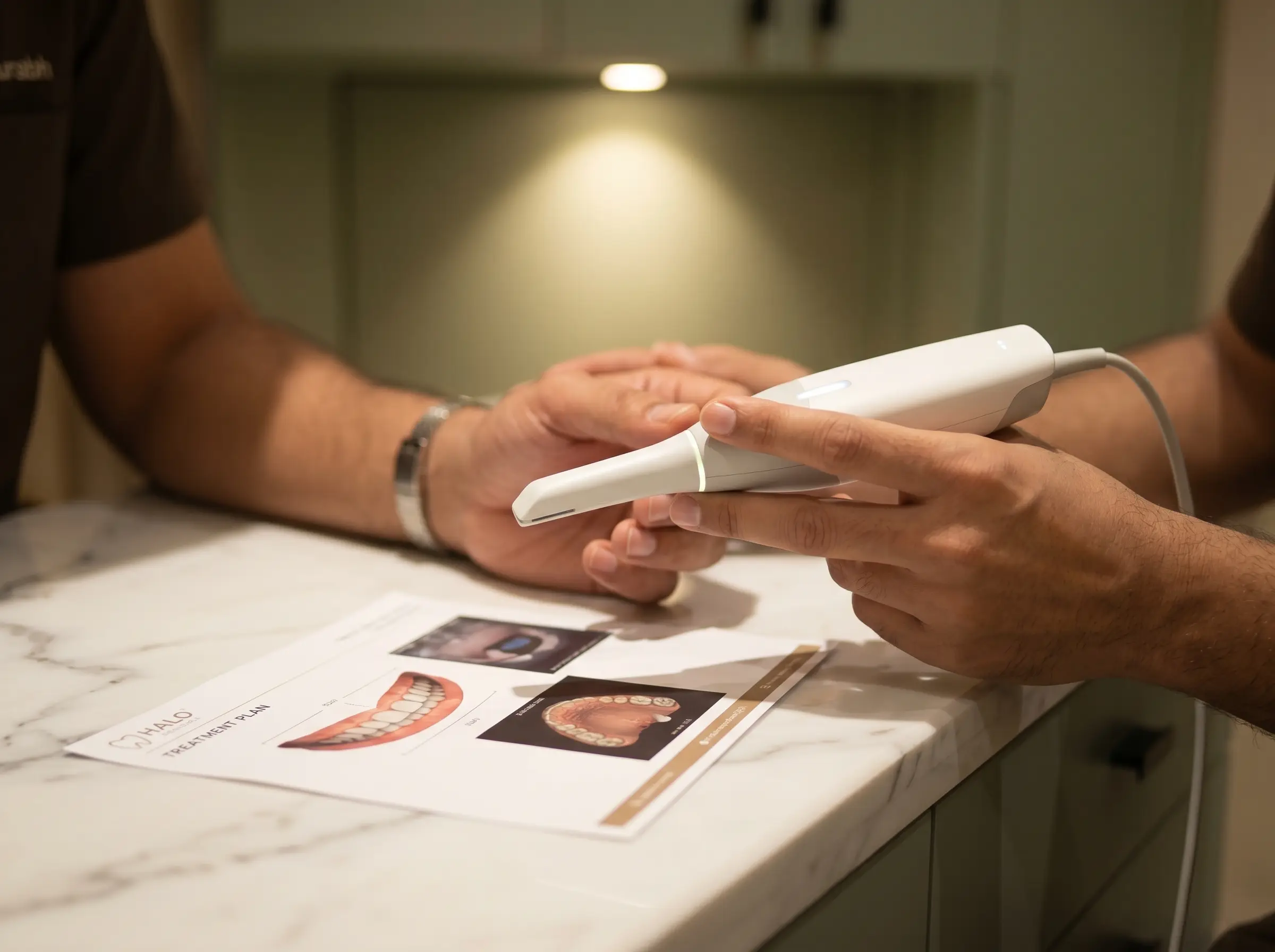
A 3D intraoral scan of the prepared tooth and surrounding dentition replaces traditional impression trays. The scan data is used to fabricate the restoration to exact specifications, ensuring a precise fit that requires minimal adjustment at the fitting appointment.
Temporary Restoration & Fabrication
A temporary restoration protects the tooth while the permanent inlay, onlay, or overlay is fabricated in the laboratory, typically one to two weeks.
Bonding & Finishing
The restoration is tried in, checked for fit, bite, and shade, then bonded permanently to the tooth with a high-strength dental adhesive. The bond between ceramic and tooth structure is one of the strongest in restorative dentistry. The surface is polished and the bite verified before you leave.
What Inlays, Onlays & Overlays Do for You
More Tooth Preserved
A crown requires the removal of tooth structure from all four sides of the tooth, including healthy enamel. An inlay, onlay, or overlay removes only what is damaged, leaving the healthy portions of the tooth intact. The natural tooth structure that is preserved is always stronger than any material used to replace it.
Natural in Appearance
Ceramic inlays, onlays, and overlays are shade-matched and surface-textured to blend seamlessly with the surrounding tooth. The restoration is invisible in normal function.
NA
NA
Long-Lasting
Ceramic inlays and onlays, with proper care, last fifteen years or more, significantly longer than large direct composite fillings and comparable to crowns, with less tooth removal required to place them.
More Durable Than a Large Filling
In a large cavity or heavily restored tooth, a direct composite filling is more likely to crack, leak, or fail over time under chewing forces. A ceramic inlay or onlay is fabricated under laboratory conditions to precise tolerances and bonded with a strength that direct fillings cannot achieve.
What to Expect
NA
- First Appointment: Preparation, 3D scan, temporary restoration, completed under local anaesthesia.
- Between Appointments: Avoid very hard or sticky foods on the temporary. Mild sensitivity is normal.
- Second Appointment: Restoration tried in, adjusted if needed, and bonded permanently. Bite checked and polished before you leave.
- Ongoing Care: Brush and floss normally. The bonded margins are the most important area to keep clean; good hygiene here determines longevity.
Why Halo 32 for Inlays, Onlays & Overlays
NA

The Most Conservative Recommendation
At Halo 32, the default is always the restoration that preserves the most tooth structure while meeting the clinical requirement. Where an onlay does what a crown would do, with less removal, the onlay is recommended.
Fabricated From Accurate Data
3D digital scanning ensures the restoration is fabricated from a precise model of the prepared tooth. The fit at the fitting appointment reflects the accuracy of that data, and at Halo 32, that accuracy is high.
Ceramic as Standard
All inlays, onlays, and overlays at Halo 32 are fabricated from high-quality ceramic, durable, natural in appearance, and bonded to the tooth with strength that composite cannot match.
NA
FAQs
Why not just use a filling?
In a large cavity, particularly in a back tooth under significant chewing load, a direct composite filling has limitations. It is more susceptible to microleakage at the margins, more likely to fracture under repeated force, and less durable over the long term than a ceramic inlay or onlay. For moderate to large restorations where longevity matters, the indirect ceramic restoration is the more reliable choice.
Why not just have a crown?
A crown requires removing healthy tooth structure from every surface of the tooth, including areas that are perfectly intact. For a tooth where damage is confined to the biting surface or one or two cusps, this is unnecessary. An inlay, onlay, or overlay restores what needs restoring and preserves the rest. Less removal means a stronger remaining tooth and a restoration that does less damage to the long-term health of the tooth underneath.
How long do inlays and onlays last?
With proper oral hygiene and regular check-ups, ceramic inlays and onlays typically last fifteen years or more. Longevity depends on the size and location of the restoration, your bite forces, and how well the margins are maintained with oral hygiene. We assess existing restorations at every routine visit.
Is the procedure painful?
No. Preparation is performed under local anaesthesia. You may feel pressure but no pain during the appointment. Some mild sensitivity in the prepared tooth during the temporary phase is normal and resolves when the permanent restoration is bonded.