
Dental Crowns in Pune
What Is a Dental Crown?
Who Should Consider a Dental Crown?
A crown is the appropriate restoration when a tooth’s structural integrity has been sufficiently compromised that a filling would be inadequate or unreliable. You may need a crown if:
- A tooth has a large cavity that has destroyed too much of its natural structure for a filling to hold.
- A tooth is cracked or fractured, particularly if the crack extends towards or below the gum line.
- A tooth has undergone root canal treatment and needs full coverage to prevent fracture.
- An existing large filling has failed, cracked, or is causing the tooth to flex under bite forces.
- A tooth is severely worn down from grinding or erosion.
- You are having an implant placed and the crown is the visible restoration that attaches to it.
Crowns are also used for cosmetic purposes, to reshape, resurface, or change the shade of a tooth where veneers are not appropriate. Your dentist will recommend the most conservative option that achieves the clinical and aesthetic outcome required.
Your Crown Treatment at Halo 32
Assessment & Planning
Digital imaging confirms the condition of the tooth, the surrounding bone, and the gum tissue before treatment is planned. The appropriate crown material, design, and shade are discussed with you at this stage.
Tooth Preparation
The tooth is shaped under local anaesthesia to create space for the crown. The amount of tooth structure removed is determined by the crown material and the condition of the existing tooth; at Halo 32, preparation is as conservative as the clinical situation allows.
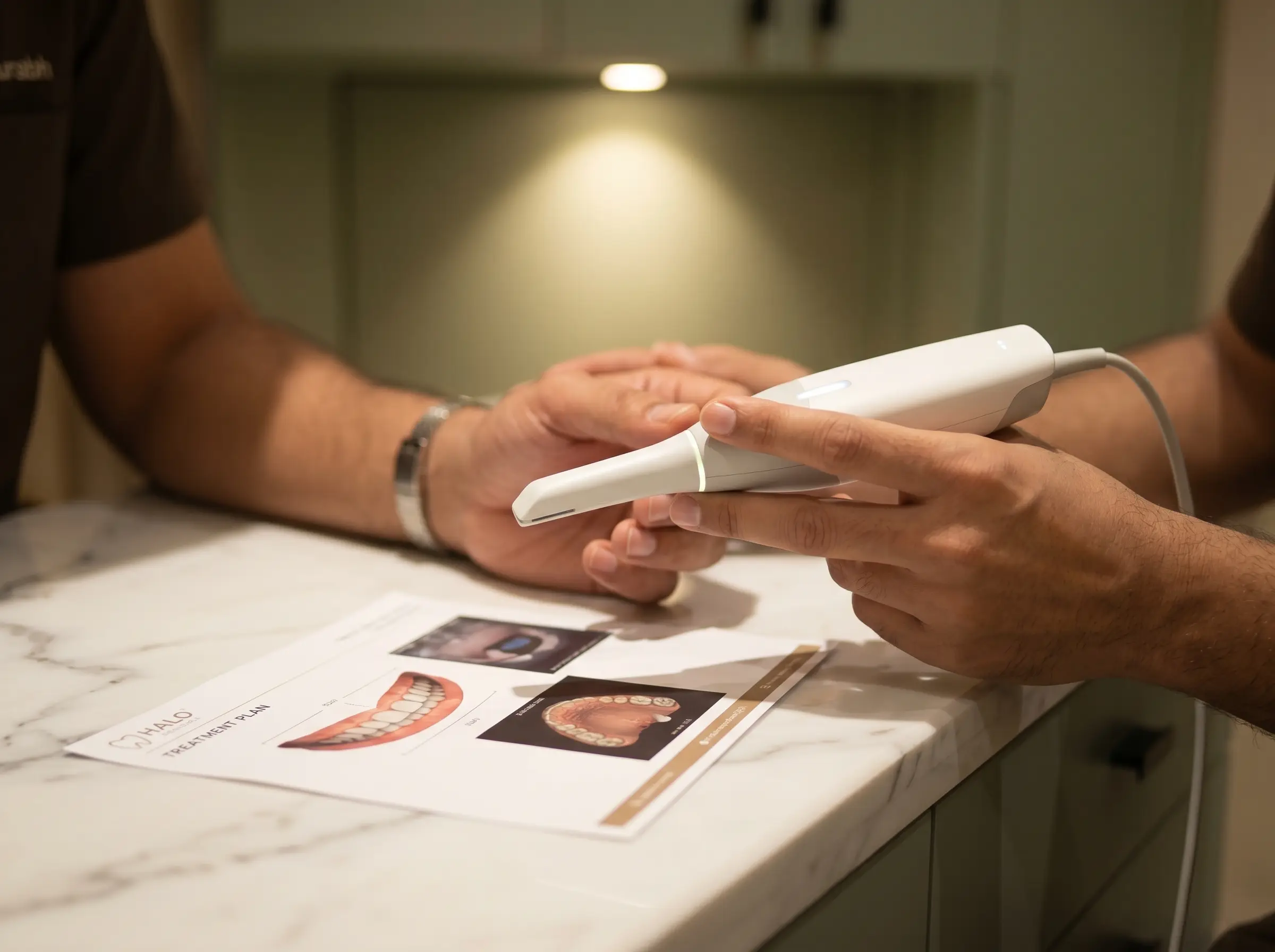
3D Digital Scan
A 3D intraoral scan of the prepared tooth replaces traditional impression trays entirely. The scan captures the precise dimensions of the preparation, the surrounding teeth, and the bite, providing the accuracy that crown fabrication requires, without the discomfort of impression materials.
Temporary Crown
A temporary crown is placed over the prepared tooth while the permanent crown is fabricated in the laboratory, typically one to two weeks. The temporary protects the tooth and maintains function and aesthetics during this period.
Final Fitting
The permanent crown is tried in, checked for fit, shade, and bite accuracy, and adjusted as needed before being permanently cemented. The result is a restoration that fits precisely, looks natural, and functions exactly as the tooth it replaces.
What a Dental Crown Does for You
Restores Full Tooth Strength
A crown encases the entire tooth above the gum line, distributing biting forces evenly across the whole structure. A weakened tooth that was at risk of fracture is fully protected once a crown is in place.
Prevents Fracture
Teeth that have undergone root canal treatment, or that have large existing restorations, are at significantly elevated risk of catastrophic fracture. A crown eliminates that risk, protecting the tooth from forces that a filling cannot manage.
NA
NA
Natural in Appearance
Modern ceramic crowns are fabricated with translucency, shade, and surface texture that closely replicate natural enamel. A well-made crown is difficult to distinguish from the surrounding teeth.
Long-Lasting Protection
A properly fitted ceramic crown, maintained with good oral hygiene and regular check-ups, provides reliable protection for ten to fifteen years or longer. It is one of the most durable restorations in dentistry.
What to Expect
NA
- First Appointment: Preparation, 3D scan, and temporary crown, completed under local anaesthesia. Mild sensitivity under the temporary is normal.
- Between Appointments: The temporary crown protects the tooth. Avoid very sticky or hard foods on that side. If the temporary comes loose, contact us; do not leave the tooth unprotected.
- Second Appointment: Permanent crown fitted, checked, and cemented. Bite verified before you leave.
- Ongoing Care: Brush and floss normally. The crown itself cannot decay, but the tooth margin where it meets the gum line can. Good oral hygiene at this junction is important.
Why Halo 32 for Dental Crowns
NA

3D Digital Scanning, No Impression Trays
The accuracy of a crown depends entirely on the accuracy of the data it is fabricated from. At Halo 32, 3D digital scanning replaces traditional impressions, producing a more accurate model of the prepared tooth, more comfortably, and without the distortion that impression materials introduce.
Ceramic as Standard
Halo 32 uses durable, natural-looking ceramic for all crowns, no metal-ceramic combinations with visible metal margins. The result is a restoration that looks and behaves like natural enamel.
Conservative Preparation
The goal at Halo 32 is always to remove the minimum tooth structure consistent with the clinical requirement. Preparation is planned and executed conservatively, preserving as much of the natural tooth as the restoration allows.