
Dental Bridges in Pune
What Is a Dental Bridge?
A dental bridge replaces one or more missing teeth with a custom-made artificial tooth, called a pontic, that is supported by crowns placed on the neighbouring teeth or implants on either side of the gap. The bridge is fixed in place and functions like natural teeth, restoring your ability to chew, correcting bite alignment, and preventing the neighbouring teeth from drifting into the empty space over time.
At Halo 32, bridges are designed using 3D digital scanning for accuracy and fit, and fabricated from ceramic materials that blend naturally with your existing teeth in shade, shape, and proportion.
Who Should Consider a Dental Bridge?
A dental bridge is a suitable option for patients missing one or more teeth who want a fixed restoration without implant surgery. You may be a candidate if:
- You are missing one or more teeth and want a fixed, non-removable replacement
- The neighbouring teeth on either side of the gap are healthy enough to serve as supports, or implants are already in place to anchor the bridge
- You want to restore chewing function and bite balance in the area of the missing tooth
- You want to prevent the neighbouring teeth from drifting into the gap over time
- Implant surgery is not suitable for you due to insufficient bone, medical considerations, or personal preference
Before recommending a bridge, your dentist will assess the condition of the neighbouring teeth, the volume of bone in the gap, and discuss all available options, including implants. Where both are possible, the clinical advantages and long-term considerations of each will be explained clearly.
Your Bridge Treatment at Halo 32
Assessment & Treatment Planning
Digital imaging assesses the missing tooth site, the condition of the neighbouring teeth, and the surrounding bone. The bridge design, number of units, material, shade, and fit are planned with reference to your bite and the aesthetics of your full smile.
Preparation of Supporting Teeth
The teeth on either side of the gap are prepared to receive the crowns that will anchor the bridge. This involves removing a thin layer of enamel from each tooth to create space for the crown. Local anaesthesia ensures the procedure is comfortable throughout.
3D Digital Scan
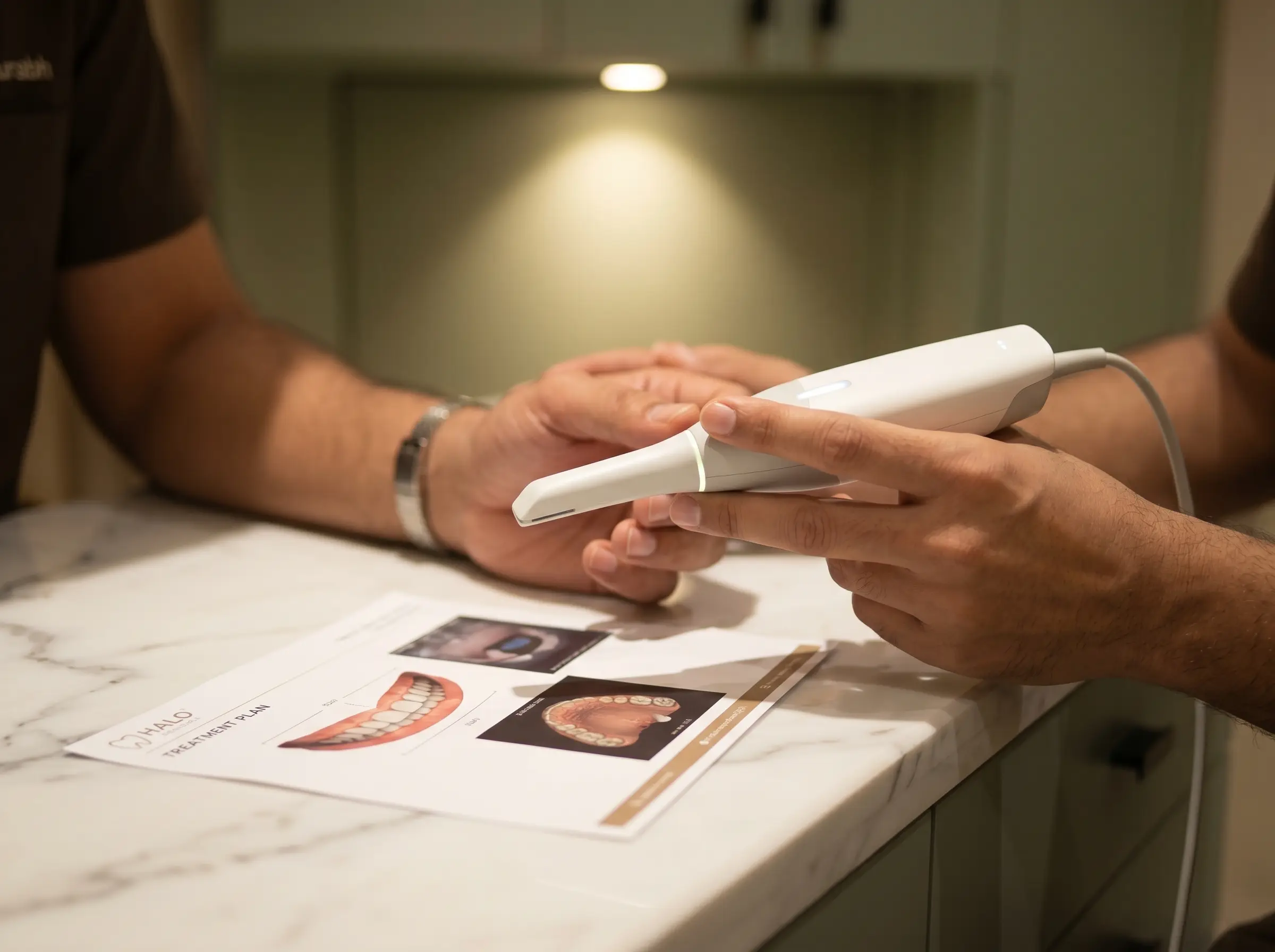
A 3D intraoral scan captures the prepared teeth, the gap, and the surrounding dentition with precision. This replaces traditional impression trays and provides the accuracy required for the bridge to fit correctly at the fitting appointment, without the need for adjustments or remakes.
Temporary Bridge
A temporary bridge is placed immediately after preparation, protecting the teeth and maintaining aesthetics and function while the permanent bridge is fabricated, typically one to two weeks.
Final Fitting
The permanent bridge is tried in, checked for fit, shade accuracy, and bite, and adjusted as needed before being permanently cemented. The result is a fixed restoration that looks natural, fits precisely, and restores full function to the area.
What a Dental Bridge Does for You
Restores Chewing Function
A missing tooth reduces chewing efficiency in that area and places additional load on the remaining teeth. A bridge restores full function to the gap, distributing bite forces correctly and protecting the surrounding teeth from overload.
Prevents Teeth From Shifting
Teeth adjacent to and opposing a gap gradually drift towards the empty space over time, changing the bite and creating new problems. A bridge fills the space and holds the surrounding teeth in their correct positions.
NA
NA
Fixed and Non-Removable
A bridge is cemented permanently in place. It does not move, does not require removal, and is cleaned like natural teeth with brushing and floss threaders under the pontic. There is no adjustment period; function is restored immediately.
Natural in Appearance
The pontic and crowns are fabricated from ceramic, shade-matched and shaped to blend with your surrounding teeth. A well-designed bridge is difficult to distinguish from the natural teeth beside it.
What to Expect
NA
- First Appointment: Preparation, 3D scan, temporary bridge, completed under local anaesthesia. Some sensitivity under the temporary is normal.
- Between Appointments: Avoid very sticky or hard foods on the temporary bridge. If it comes loose, contact us promptly.
- Second Appointment: Permanent bridge fitted, checked, and cemented. Bite verified and adjusted before you leave.
- Ongoing Care: Brush normally. Use a floss threader or interdental brush to clean under the pontic daily; this is the most important maintenance step for bridge longevity.
Why Halo 32 for Dental Bridges
NA

3D Digital Scanning for Precision Fit
The fit of a bridge is determined by the accuracy of the data used to fabricate it. At Halo 32, 3D digital scanning replaces traditional impressions, producing a more accurate model of the prepared teeth and gap, and a bridge that fits correctly the first time.
Ceramic as Standard
Every bridge at Halo 32 is fabricated from durable ceramic, natural in appearance, free of metal margins, and designed to integrate seamlessly with your existing teeth.
Honest About the Options
Before recommending a bridge, we discuss implants, because for many patients missing a single tooth with healthy neighbours, an implant is the more conservative long-term option. If a bridge is the right choice for your situation, we will explain precisely why. If an implant would serve you better, we will say that too.
NA
FAQs
How long does a bridge last?
A well-made ceramic bridge, maintained with good oral hygiene and regular check-ups, typically lasts ten to fifteen years. Longevity depends on the condition of the supporting teeth, your bite, and how thoroughly you clean under the pontic. We assess existing bridges at every routine visit.
Is a bridge better than an implant?
They are different solutions with different advantages. A bridge is faster, non-surgical, and does not require bone volume, but it requires the neighbouring teeth to be prepared. An implant leaves the neighbouring teeth entirely untouched, supports jawbone health, and typically lasts longer. Where both are clinically appropriate, an implant is usually the more conservative long-term option. Your dentist will outline both clearly before recommending either.
Does getting a bridge hurt?
The preparation procedure is performed under local anaesthesia. You will feel no pain during the appointment. Some sensitivity in the prepared teeth in the days following is normal and settles as the temporary bridge is in place. The final fitting is typically straightforward and comfortable.
Can I eat normally with a bridge?
Yes. Once the permanent bridge is cemented, you can eat normally. Avoid habits that put excessive force on any fixed restoration, such as biting nails, opening packaging with teeth, or chewing ice, which apply to natural teeth equally.